
What About My Security Clearance?
I’ve done bankruptcies for nearly a thousand people who have security clearances. Some people were so nervous about their clearance when they talked to me. Some of others were warned by their security people that they would lose their clearance unless they filed for bankruptcy! A few people had lost their clearances and hoped to get it back.
Not paying your debts can be automatic grounds for losing your clearance–because the government does not want you desperate for money and selling things that don’t belong to you.
My Favorite Security Clearance Story
Antoni came to see me in early 2002. He was trying to get a job at the Transporation Security Administration, which had just been established after the 9/11 attacks. He had military training–with a friendly force, not US military–and TSA was looking for people with military training.

But he was disqualified from working at TSA because of bad debts on his credit.
I told him filing for bankruptcy would improve his chances of getting cleared. He thought about it, and decided to go ahead.
Later that year, I was at Dulles Airport, I was flying to the annual convention of the National Association of Consumer Bankruptcy Attorneys. Antoni was the TSA agent checking my IDs.
 An FBI Security Clearance Story
Kaitlin, a young lawyer, worked for me 2012-2014. In 2015 she took a job with the Depoartment of Justice.
The FBI does background and clearance investigations for the Justice Department. So an FBI agent came to talk to me about Kaitlin’s background.
The FBI agent doing clearance investigations had filed bankruptcy with me in 2009.
A Military Clearance Story
Rod was stationed at a base in the Midwest,and his chain of command wanted him in an important job in Virginia. Even with the support of his chain of command, he couldn’t get cleared for that promotion because he had a repossesion on his credit. Filing bankruptcy got him cleared.
(More details on Rod’s story are here.)
I Can’t Promise 100%
I have known six people who lost their security clearance after filing for bankruptcy. (None in the last ten years.) Three of those had been ignoring their bills and dragging around bad credit for years without doing anything about it. At their review, the government said they were just too stupid to be trusted. (Bankruptcy by itself cannot be used to deny a security clearance, but it can be used against you in combination with other problems.) Of the other three, one worked at perhaps the most secure location in government. (He kept his clearance but was transferred to a different location.) The other two I can’t explain.
I have seen several people who did not have clearances and who were denied interim clearances because of the bankruptcy, when they applied. I fought one of those to the Fourth Circuit, but lost.
Self-Report; Self-Report
There’s a common thread in the people who lost their clearances after filing bankruptcy. None of them self-reported.
If there’s a major life change, you have an obligation to self-report. So if you haven’t already, talk to your clearance officer tomorrow. Say, “I’m in financial trouble; I’m consulting with a lawyer on what to do.”
In most cases, your clearance officer will say something like, “ok, just keep me posted.”
Security Clearances And Bankruptcy
People who already have a clearance and who aren’t in trouble for anything else do not lose their clearances because of bankruptcy. People who are applying for a clearance for the first time should do everything possible to keep everything current until the clearance is approved.
In some parts of government and certain jobs, filing a Chapter 13–and paying back some of your debts–is better than filing a Chapter 7. If you are a security clearance officer yourself, you know what I’m talking about.
Bankruptcy is always better for your clearance than a history of late payments and charged-off debts.
P.S. If you haven’t read the many client reviews we have, then be sure to. You might just be surprised at what you discover.

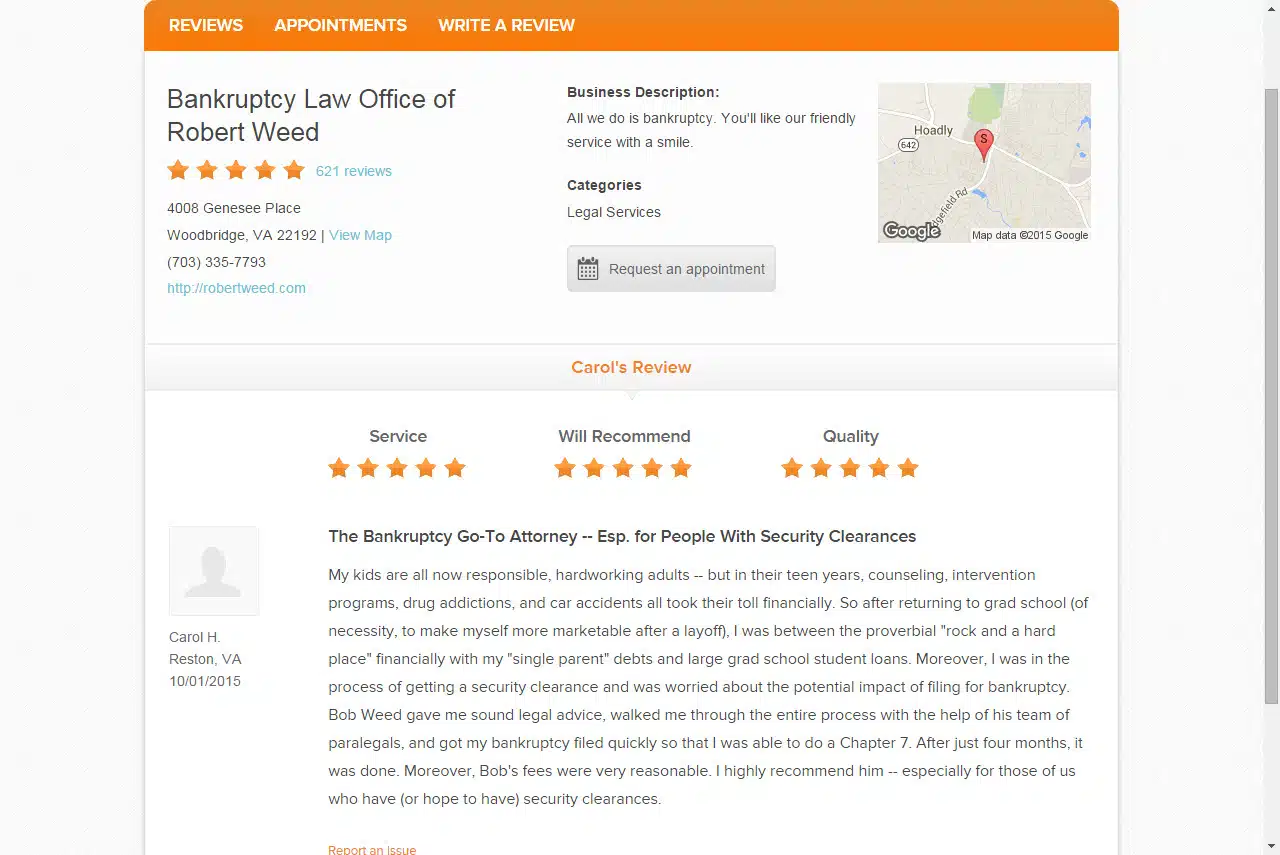
P.P.S. If you are still nervous about your clearance, read this review from the fall of 2015.